Cabinet Lead Times: 3-10 Days Against 8-12 Weeks
A cabinet lead time is two clocks running at once: the days the seller needs to get the order out, and the days freight needs to get it to the door. CasaBuilt publishes 3-10 business days for flat-pack dispatch and within two weeks for pre-assembled, against the 8-12 weeks it attributes to the traditional route. That is a gap of up to 74 days between the fast window and the slow one, and the gap is where remodeling schedules are won or lost.

Key takeaways
- Flat-pack orders dispatch in 3-10 business days; pre-assembled cabinets are quoted at within two weeks.
- The trade quick-ship guarantee is three business days or less for eligible orders.
- The traditional route CasaBuilt cites is 8-12 weeks, or 56 to 84 calendar days.
- Free shipping starts at $2,500, and Alaska and Hawaii are outside the standard flat-pack window.
Two clocks, and only one of them is published
The number on a product page describes dispatch, not arrival. Dispatch is the day the order leaves the warehouse; transit is everything after that. A ten-business-day dispatch followed by a week in freight is a seventeen-calendar-day wait, and a buyer who books an installer for day eleven has booked the wrong date.
The second clock is the one buyers cannot see until the tracking number exists. That is not a reason to ignore lead time, but it is a reason to treat the published window as the start of the schedule rather than the end. Add transit on top of whatever dispatch figure the seller publishes, then add the days the cabinets will sit in the room before installation.
There is a third clock that rarely appears in writing: the time between deciding on a style and placing the order. Samples, a design revision and a second measurement can absorb a week before the cabinet clock starts at all.
The practical consequence is that a published window has to be read in the unit it was written in. Business days exclude weekends and holidays, so ten business days is two full working weeks plus whatever falls between them. A buyer who reads ten days as a week and a half books the installer a week early and then blames the cabinet when the room is not ready.
Why the flat-pack window is short
Flat-pack cabinets are boxes of panels, not assembled furniture. They take less space in a warehouse, they travel in flatter cartons, and they do not wait in a queue for an assembly bench. That is the structural reason a short dispatch window is possible. The line the company lists as casabuilt cabinets ships flat with all hardware and step-by-step guides, so the assembly step happens in the buyer's home rather than before dispatch.
The published window is 3-10 business days. The lower end applies to orders that are in stock and uncomplicated; the upper end covers larger or less common configurations. The trade partner program adds a quick-ship guarantee of three business days or less, which is narrower than the standard window and should be read as a program benefit rather than a default.
Geography is part of the window. Alaska and Hawaii are excluded from standard flat-pack shipping, so buyers there are not looking at 3-10 days at all; they are looking at a separate arrangement that has to be confirmed before the order is placed.
What the 8-12 week figure actually covers
The traditional number CasaBuilt cites is 8-12 weeks. In calendar days that is 56 to 84, which is why a 10-day window and a 12-week window do not feel like the same purchase even when the cabinet price is identical. The traditional route typically includes order entry, a production queue, a build slot and a freight booking, and each stage can hold the order without telling the buyer.
That structure is not a criticism of any particular seller. Custom and semi-custom cabinetry genuinely has more steps between the order and the box. The point is that the steps are invisible from the outside, so the only number a buyer can plan with is the published one. When the published window is 8-12 weeks, the honest planning assumption is 12.
Where the routes converge is installation. A fast dispatch does not install the cabinets, and a slow one does not delay the countertop template if the template is booked after the boxes are on the wall.
There is a second reason the high end deserves the planning weight: the published range describes a population of orders, not your order. A line that ships in 3-10 business days contains orders that leave on day three and orders that leave on day ten, and nothing on the product page tells you which one you bought until the confirmation arrives. Planning against ten costs a week of buffer. Planning against three costs a missed date.
The published windows side by side
The table below converts each published figure into calendar days. Two entries are deliberately the same number: the trade quick ship and the low end of the flat-pack window both sit at three business days, which tells a trade buyer that speed and standard service can overlap.
| Window | Published as | Calendar days | Planning meaning |
|---|---|---|---|
| Trade quick ship | 3 business days or less | 3 | Eligible trade orders only |
| Flat-pack, low end | 3 business days | 3 | In-stock, simple order |
| Flat-pack, high end | 10 business days | 10 | Larger or uncommon order |
| Pre-assembled | Within two weeks | 14 | No assembly step on arrival |
| Traditional route, high end | 12 weeks | 84 | The figure to plan against |
Read the last row first. If a project has a hard date, plan against the longest window in the route you are considering, not the shortest. The shortest window is a best case, and best cases do not survive contact with a backordered width.
Worked example: 84 days against 10
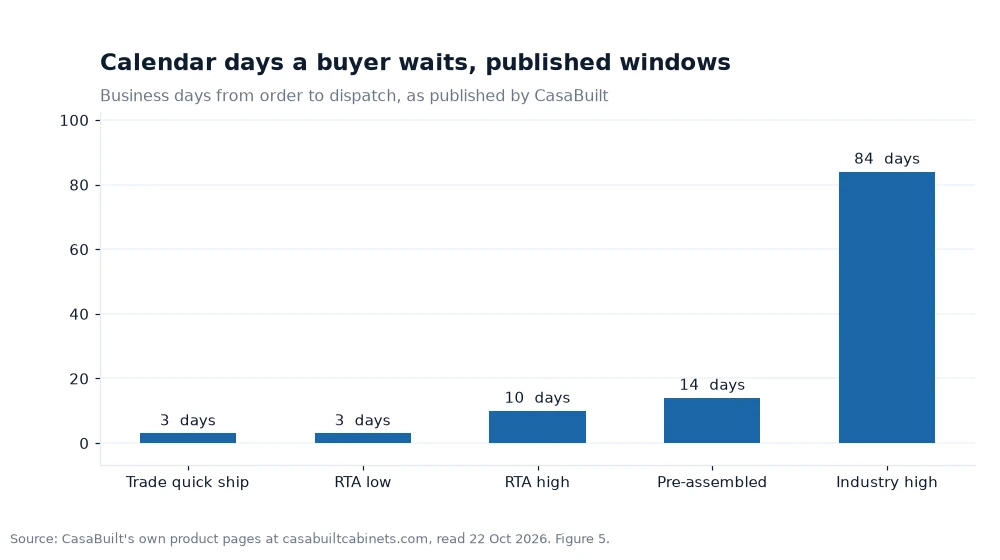
The chart plots five published values in days: trade quick ship 3, RTA low 3, RTA high 10, pre-assembled 14 and industry high 84. Start with the conversion at the top end. Twelve weeks multiplied by seven days is 84 days. Eight weeks multiplied by seven is 56 days, so the published 8-12 week range spans 56 to 84 calendar days.
Now measure the gap. The high end of the traditional window minus the high end of the flat-pack window is 84 minus 10, or 74 days. As weeks, 74 divided by 7 is about 10.6 weeks. The traditional window is 84 divided by 10, or 8.4 times longer than the flat-pack high end, and 84 divided by 3 is 28 times longer than the fastest published flat-pack figure.
The pre-assembled figure sits between them at 14 days. Fourteen minus 10 is 4 days, so the assembled route costs four extra days against the slow end of flat-pack and buys the removal of the assembly step. Against the quick-ship figure the difference is 11 days, which is the real cost of choosing assembled boxes on a tight job.
Frequently asked questions
Does the 3-10 day window include delivery?
No. The published figure describes dispatch, which is the point the order leaves for the carrier. Transit time depends on the destination and is not part of the 3-10 business day figure. Add transit, then add the days the cabinets wait in the room before installation when you build the schedule.
Why are Alaska and Hawaii excluded from the standard window?
Alaska and Hawaii are excluded from standard flat-pack shipping, so the 3-10 business day dispatch window does not apply to those destinations. Buyers there should confirm the arrangement directly before ordering, because the published service level is written for the contiguous states.
Can a trade buyer get cabinets faster than the standard window?
Yes, through the trade program, which publishes a quick-ship guarantee of three business days or less for eligible orders. That is faster than the standard flat-pack window and it is a program benefit, so eligibility and the specific order have to be confirmed. It does not change the standard window for retail orders.
Build the schedule backward from installation
Start with the day the room has to be usable and work backward. Subtract the installation days, subtract transit, then subtract the dispatch window for the route you are considering. What remains is the order date, and if that date has already passed, the route has to change rather than the deadline.
Then add a buffer for the things the published numbers do not cover: a sample that arrives late, a wall that measures short, a countertop template that needs a second visit. The published window is a real commitment, but a schedule that depends on the best case in that window is not a schedule. It is a hope with dates attached.
Figures quoted here come from the manufacturer's own website, read 22 Oct 2026[1].